
In many organizations, there is a genuine desire to improve things. Operational excellence initiatives, progress plans, CSR roadmaps, and cross-functional actions are piling up… But when it comes to following up on them, those in charge find themselves alone, juggling scattered Excel spreadsheets, untracked emails, and manual follow-ups. This reality is even more striking in multi-site organizations.
When initiatives pile up without an overall vision, when monitoring gets lost in the maze of disparate tools, continuous improvement moves forward… but in the dark! In such a context, progress loses speed, efficiency, and strategic consistency. To gain global visibility, align priorities, and optimize management, the solution is clear: bring all your initiatives together in a single, collaborative space. This is the only way to ensure structured, real-time monitoring while strengthening collective commitment.
Why should you centralize your continuous improvement initiatives?
To better understand the concept of centralizing initiatives, let’s first look at why they often struggle to last over time.
The reasons why continuous improvement initiatives quickly run out of steam
Today, companies are stepping up their efforts to move forward: improvement plans, Lean initiatives, CSR projects, quality initiatives, innovations, etc. But the more initiatives there are, the more complex it becomes to monitor them. Even the most well-intentioned continuous improvement initiatives can lose momentum if they are not based on clear organization and appropriate tools.
Among the main causes of this stagnation are:
- A lack of regular guidance: without effective management rituals, momentum weakens and teams become demotivated.
- The absence of centralized management: each site, service, or department works independently, which increases duplication and makes coordination difficult.
- Insufficient cross-functional visibility: strategic priorities get lost in the mass of local initiatives, which are sometimes unrelated to overall objective.
In this context, it becomes difficult to maintain a common course, identify obstacles, and promote successes. Continuous improvement does not falter due to a lack of will, but often due to a lack of tools and methods to support the effort over time.
Continuous improvement: the challenge of Excel’s multiple layers
Among the major causes of this slowdown, the tools used to monitor initiatives play a decisive role.
In many organizations, management still relies on a pile of Excel spreadsheets, shared files, and email exchanges. While these tools are practical for one-off needs, they quickly prove inadequate when it comes to managing a portfolio of initiatives across an entire company or multi-site network.
Their use inevitably leads to:
- Fragmented monitoring by site or department: information is scattered and difficult to consolidate.
- Manual updates: these take up valuable time and are often incomplete or obsolete.
- Time-consuming steering committee meetings: preparation takes longer than analysis and decision-making
- A gradual loss of meaning for teams: without an overall vision, efforts seem isolated and undervalued.
These tools simply prevent a reliable, real-time overview. Continuous improvement managers are then forced to “steer blind” and find themselves unable to provide visibility to their teams… simply because they don’t have it themselves!
And it is precisely this lack of visibility that makes it essential to set up a single collaborative space capable of centralizing information, providing an overview, and restoring momentum to continuous improvement.
The tangible benefits of a single collaborative space
Faced with the limitations of Excel and scattered tools, a centralized collaborative space becomes a real performance lever for continuous improvement.
By bringing all initiatives together in a single, accessible, and constantly updated environment, organizations radically transform the way they manage and monitor their actions.
The benefits are immediate:
- A 360° view of the entire portfolio, with real-time tracking of projects, their progress, and their results.
- A single source of truth: no more hunting for “the right version” of a file—everyone works on the same data.
- Enhanced coordination between sites, departments, and teams thanks to integrated communication and sharing tools.
- Simplified and proactive monitoring thanks to visual dashboards, key indicators, and automatic alerts in the event of blockages or approaching deadlines.
- Recognition of efforts with shared visibility on everyone’s successes and contributions, promoting engagement and recognition.
By centralizing information, the collaborative space puts an end to blind management, gives meaning to the actions taken, and allows decision-makers and field teams to work with a clear, shared, and results-oriented vision.
Implementing a structured and collaborative management approach
Moving from fragmented monitoring to structured, collaborative management is key to ensuring continuous improvement over time.
The goal is not only to bring initiatives together in one place, but also to establish a clear framework, common methods, and regular coordination to maintain team engagement and strategic consistency.
Structure the continuous improvement process
Effective management relies on a well-defined process shared by all stakeholders:
- Capture initiatives: centralize all ideas, projects, and proposed actions, whether they come from the field, management, or regulatory requirements.
- Evaluate and prioritize: analyze each initiative according to objective criteria (impact, feasibility, strategic alignment) to decide whether to launch it.
- Implement and monitor: assign responsibilities, monitor progress in real time, and adjust the plan if necessary.
- Close and capitalize: formalize results, share lessons learned, and promote successes.

This clear and shared cycle enables a shift from reactive reporting to proactive management, where each step is tracked and transparent.
For more information, see our article on how to structure a continuous improvement process.
Provide rhythm and visibility
A collaborative space is only valuable if it is regularly animated. To maintain energy and avoid running out of steam, it is essential to:
- Plan rituals: monthly reviews, steering committees, short but frequent progress updates.
- Use visual dashboards to display progress, performance indicators, and alerts.
- Send automatic notifications to remind people of deadlines, report bottlenecks, or share successes.
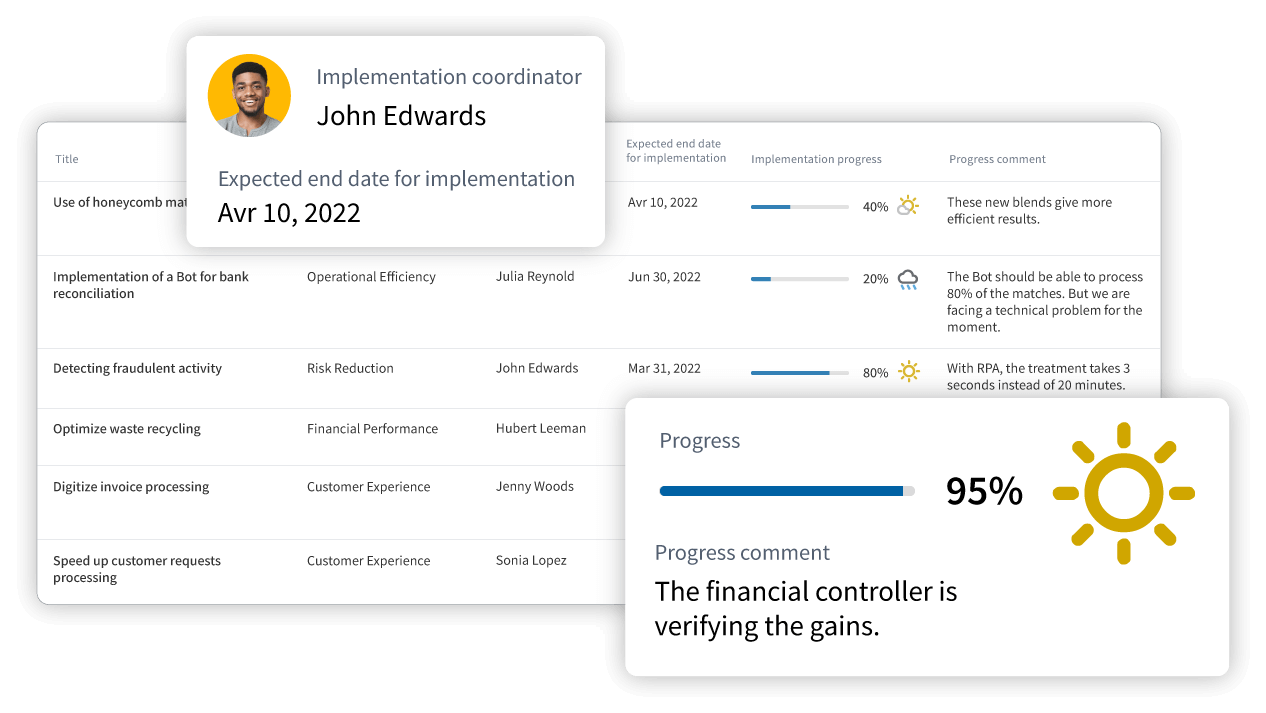
This regular animation allows everyone to stay aligned, anticipate deviations, and recognize efforts.
Promoting collaboration and ownership
For governance to be truly collaborative, each stakeholder must be able to contribute easily, and the tool used must be perceived as an aid rather than a constraint, with:
- Clear roles and responsibilities: everyone knows what they have to do and when to intervene.
- Transparent information sharing: data is accessible at all levels of the organization, promoting trust and involvement.
- Recognition of contributions: highlight successes, celebrate victories, encourage participation.
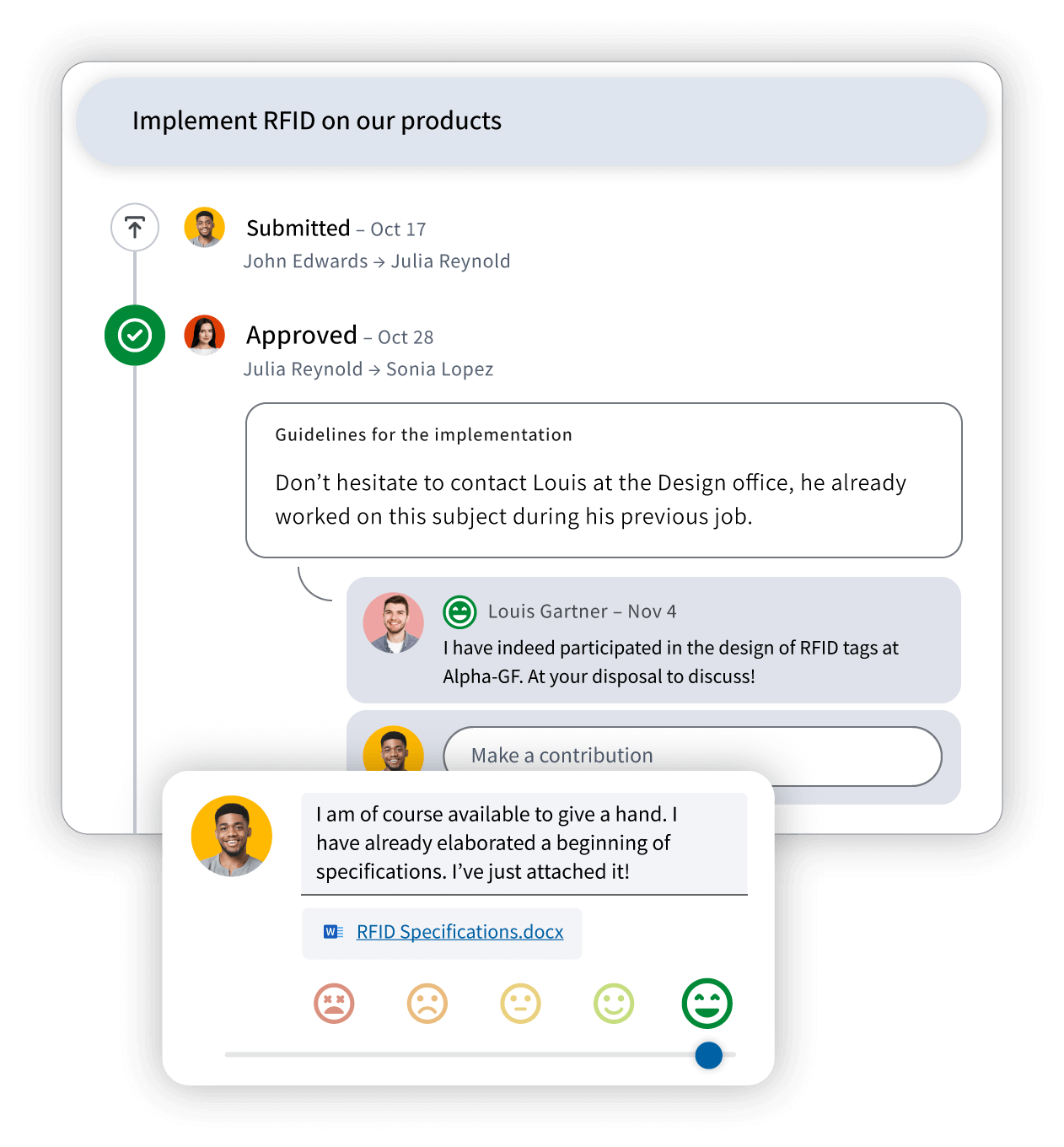
By establishing a clear framework, setting the pace, and encouraging everyone to take ownership, structured and collaborative management becomes a powerful driver of continuous improvement.
On this topic, see our article on how to involve managers and teams in continuous improvement.
Examples and solutions to guide your actions
Among the existing tools, IDhall is a collaborative platform designed to centralize, structure, and track all continuous improvement initiatives within an organization, regardless of their origin or stage of progress.
In practice, this means:
- Having a comprehensive and up-to-date overview of all initiatives,
- Facilitating coordination between different sites, departments, or business lines,
- Reducing the time spent preparing reports and follow-ups,
- Highlighting efforts and successes through shared visibility.
For a concrete example of implementation, see our article on managing irritants.

This structured, collaborative framework enables organizations to become more efficient and transparent, while strengthening team engagement.
IDhall currently supports organizations that vary greatly in size and sector, but all share the same goal: to better monitor their initiatives, engage their teams, and achieve concrete results.
Here are some inspiring examples, grouped by sector.
IDhall in the industrial sector
In industry, centralizing and sharing initiatives not only saves time, it also strengthens team cohesion and speeds up project implementation. Here’s how several industrial companies use IDhall on a daily basis:
- Industries FM: in two and a half years, the company has carried out 115 improvement initiatives, mobilizing all staff and widely disseminating best practices.
- EBS Emballage: by replacing Excel with IDhall, the company has improved traceability and responsiveness, while simplifying the daily work of its teams.
- SWM International: with a single repository, the average duration of R&D projects has been halved, freeing up time for innovation and increasing the number of patent filings.
IDhall in services and logistics
In services and logistics, where teams are often geographically dispersed, IDhall creates a permanent link between stakeholders and simplifies coordination. These examples show how the platform helps streamline monitoring and facilitate decision-making:
- STEF:across 250 sites in 8 countries, action plans resulting from audits are now centralized, which has strengthened coordination and accelerated decision-making.
- Sofinco: the tool makes it possible to quickly identify and address “irritants” that were hindering customer satisfaction and internal efficiency.
IDhall in the public service
In the public sector, the challenge often lies in data reliability and collaboration between departments. IDhall helps address these issues by providing a single space for managing action plans and maintaining regular monitoring. Here are two concrete examples:
- SDIS 58: Centralizing action plans has simplified updates, improved data reliability, and enhanced cooperation between departments.
- SDIS 18: The tool has structured action monitoring, given greater visibility to priority projects, and facilitated team coordination.
These examples, whether from industry, services, or the public sector, show that by centralizing continuous improvement initiatives in a single collaborative space, organizations gain not only in efficiency, but also in clarity and collective commitment. With a clear method and shared visibility, continuous improvement becomes easier to manage… and above all, more motivating for everyone involved.
FAQ
Why do continuous improvement initiatives fail to gain momentum?
Continuous improvement initiatives often fail to gain momentum due to a lack of centralized management, regular coordination, and cross-functional visibility. Without the right tools, each department works in isolation, priorities become diluted, and duplication increases. The result is a loss of momentum, demotivated teams, and reduced efficiency.
What are the disadvantages of tracking continuous improvement with Excel?
Excel quickly becomes limited as soon as the volume of initiatives increases or you start working across multiple sites. It leads to fragmented tracking, time-consuming manual updates, often outdated data, and steering committee meetings where information gathering takes precedence over analysis.
What tools should be used to drive continuous improvement?
The best tools offer a centralized space with dashboards, indicators, automatic alerts, and collaborative features. They enable real-time monitoring, better coordination, and the promotion of results. The IDhall solution meets all of these needs and goes even further by offering:
- A single repository for all initiatives, regardless of their origin;
- Visual and customizable dashboards to track progress and results;
- Integrated workflows to structure each stage of the continuous improvement cycle;
- Automatic notifications and alerts to anticipate deadlines and bottlenecks;
- Role and permission management to involve all levels of the organization;
- An open API to connect IDhall to other tools (ERP, CRM, business software such as Auditool, etc.);
- Advanced reporting features to measure impact and highlight successes.
Thanks to this combination, IDhall transforms fragmented monitoring into structured, collaborative, and results-oriented management.
How can you centralize your continuous improvement initiatives?
Centralization requires the creation of a single collaborative space, accessible to all, which brings together all initiatives, indicators, and documents. This allows you to share a common vision, align priorities, and facilitate coordination between sites, departments, and business lines.
What are the key steps in structuring continuous improvement initiatives?
An effective process consists of four steps:
- Capture initiatives,
- Evaluate and prioritize according to objective criteria,
- Implement and monitor in real time,
- Close and capitalize by sharing results and lessons learned.
How does IDhall facilitate continuous improvement management?
IDhall centralizes all initiatives in a single space, provides a real-time 360° view, simplifies monitoring with visual dashboards, and promotes collaboration between teams. It reduces the time spent preparing reports and strengthens employee engagement.
Is IDhall a solution used by large companies for continuous improvement management?
Yes. IDhall supports large industrial, service, and public sector companies, such as STEF, Sofinco, SWM International, and EBS Emballage, which use it to structure, monitor, and promote their continuous improvement initiatives.
What types of continuous improvement initiatives can be implemented with IDhall?
In industry, IDhall has enabled Industries FM to carry out 115 initiatives in two and a half years. SWM International has halved the duration of its R&D projects. In services, STEF centralizes the action plans of 250 sites in eight countries. In the public sector, SDIS 58 has made its data more reliable and simplified the updating of its action plans. Discover more examples on the dedicated page featuring testimonials from our customers.
How to deploy IDhall in a multi-site organization?
The deployment of IDhall in a multi-site organization is carried out in a gradual and structured manner. As the platform is accessible online, each site can connect instantly to a shared space, while retaining its local specificities. The process includes configuring roles and access rights, training users, migrating existing data where necessary, and then establishing common management rituals. This deployment method ensures rapid and consistent adoption, even in the most geographically dispersed environments.
Can IDhall be used with other tools?
Yes. IDhall has an open API that allows it to be easily integrated with other solutions used within the organization, such as ERP, CRM, project management software, and reporting tools. This interoperability facilitates data synchronization, avoids double entries, and creates a fluid digital ecosystem around continuous improvement.For example, the STEF organization uses IDhall in conjunction with Auditool to automatically centralize action plans from audits carried out at its 250 sites, ensuring real-time monitoring and optimized coordination.