Steering industrial performance means juggling multiple priorities: ambitious strategic projects, operational initiatives, unexpected events to be managed in a hurry… The risk? Losing sight of what’s essential and scattering your resources without any real impact.
This is where the most successful organizations stand out: they structure their initiatives, clarify their priorities and turn every challenge into an opportunity.
In this article, discover how you can regain control. From managing strategic projects to monitoring progress initiatives, learn how to methodically manage your resources to maximize their impact and achieve sustainable performance.
Driving or enduring?
Industrial performance: understanding multiple challenges
As a factory director, you know better than anyone the complexities of managing industrial performance. Your day-to-day work is marked by the need to juggle ambitious strategic projects, operational imperatives and a multitude of cross-functional issues.
Strategic projects, the pillars of a company’s roadmap, mobilize substantial resources and require impeccable execution to guarantee their long-term impact. Alongside them, specific business projects, led by management, require close coordination.
And finally, there are the continuous improvement projects, inspired by lean manufacturing, which rely on small daily changes to optimize your processes with limited resources. And let’s not forget immediate action, the famous “Just Do It” approach, where every rapid intervention can generate tangible results.
But these initiatives alone are not enough. Quality, safety and compliance with regulatory requirements are unavoidable priorities that demand vigilance and rigor. And of course, unexpected things always happen: incidents and other unwanted events upset plans and call for rapid, precise adjustments.
Add to that the management of critical stakeholders: strategic customers, key suppliers and regulatory authorities. These relationships, often underestimated, are essential to maintaining the continuity and credibility of your plant’s operations.
When a structure is lacking in organizing these multiple responsibilities, the consequences are immediate: scattered resources, projects that run out of steam, and stagnating industrial performance. Structuring initiatives, clarifying priorities and aligning each effort with precise objectives can transform complex challenges into real performance levers.
Reasons that keep your initiatives from improving your industrial performance
You launch numerous initiatives, but your industrial performance is stagnating. The multiplicity of issues at stake makes it particularly difficult to read the actions to be taken. How do you arbitrate between a strategic project, an operational emergency linked to safety, a discrepancy identified by another certification authority, and the absolute necessity of improving existing standards? Without clear organization, chaos reigns.
First of all, the accumulation of initiatives transforms the prioritization exercise into a real headache: competing initiatives pile up, dispersing resources and diluting efforts. The result? Critical projects lack support, while secondary initiatives monopolize attention.
Then, the dispersal of initiatives across a multitude of files and media drastically limits the ability to steer and monitor the actions to be taken. This lack of centralization drastically reduces the ability of teams to work together.
Last but not least, the absence of clear rules of the game, due to a mix of different initiatives, leads to a lack of understanding of the roles and responsibilities of the various players. This creates a kind of Joule effect within the company, wasting time, resources and sometimes even motivation within teams.
This chaos undermines the organization, whose daily routine resembles a meteor shower.

Structuring initiatives: the high-performance factories method
To succeed, high-performance factories organize their initiatives methodically, prioritize what really counts, and turn the unexpected into an opportunity. This structured approach guarantees maximum impact, by mobilizing the right levers and integrating all key stakeholders. Discover the key approaches to organizing your initiatives and improving your industrial performance.
Structuring initiatives according to the playgrounds
The key to effective management starts with a clear structuring of initiatives according to the playgrounds, classifying them by nature and purpose.
- Strategic initiatives, led by the Executive Committee, embody the company's major orientations. They require substantial investment and are part of the strategic roadmap. Monitored monthly, these initiatives often require the coordination of a PMO to ensure their alignment and success.
- Top management initiatives, driven by business directions, are less complex but just as vital. Although they operate in potentially compartmentalized verticals, they are equally important to the company’s success.
- Specific portfolio initiatives: Some initiatives are integrated into specific portfolios, such as R&D, digital transformation or innovation. These projects often require a precise methodology and dedicated management.
- Standards maintenance initiatives: These respond to deviations identified during audits, inspections or incidents. Led by process managers, they guarantee compliance with standards and organizational conformity, fundamental elements in ensuring operational continuity.
- Continuous improvement initiatives: These emerge from day-to-day opportunities. These actions, often carried out by teams in the field, aim to optimize working conditions and enhance operational efficiency.
Prioritize initiatives according to performance drivers
Performance drivers are a comprehensive mapping of the issues to which an organization must respond. These levers include various dimensions such as organizational performance, customer experience, employee experience, quality, safety and operational excellence.
Each initiative undertaken by the company must contribute, directly or indirectly, to strengthening one or more of these levers.
Prioritizing initiatives is often based on context and current events. In certain situations, it may be strategic to focus on a particular lever. For example, an organization may decide to focus its efforts on quality to meet certification requirements or to achieve a significant qualitative leap. Similarly, improving the customer experience may become a priority to differentiate itself in a competitive market.
Although all these dimensions are important, it is rare that an organization can address them all with the same intensity. Prioritizing one or more levers enables resources to be concentrated where they will have the greatest impact. This flexibility guarantees a response adapted to the specific needs of the moment, while ensuring continuous progress on all fronts.
Capitalize on events to trigger high-impact initiatives
The events that punctuate the life of an organization — such as audits, inspections or regulatory changes, investigations… — are often the source of new initiatives. Some of these events require more formal follow-up, as the organization needs to be able to account for the handling of the resulting initiatives.
Proactively managed, these events become opportunities to strengthen industrial performance and organizational resilience.
Integrate critical stakeholder issues into your initiatives
Depending on the context, an organization may need to pay particular attention to initiatives involving strategic stakeholders: key customers, service providers, critical suppliers or authorities essential to its business. For these exceptional initiatives, some organizations go a step further by setting up a dedicated comitology, guaranteeing rigorous monitoring and informed decisions.
Steering initiatives: governance, rituals and tools to adopt
Now that your initiatives are structured according to your specific challenges — playgrounds, performance levers, key events, critical stakeholders — you no longer have to worry about how to prioritize them and how to move forward. All you need to do is adopt the right governance, effective rituals and efficient tools to manage them successfully.
Creating organized initiative portfolios to manage your projects
These four structuring elements enable you to organize your initiatives into clear portfolios, where each action is effectively monitored, steered and coordinated. You have a precise vision of the priorities to be managed, supported by:
- Solid governance to steer each portfolio,
- Regular rituals for monitoring and arbitration,
- Appropriate tools to centralize information and measure progress.
Each initiative progresses within a well-defined framework, with clear status:
- Pending decision: Identified opportunities awaiting a green light.
- Under implementation: Initiatives that are mobilizing active resources.
- Initiative closure: Finalized projects, whose results can be measured and shared.
These status documents facilitate arbitration at governance meetings and guarantee a clear vision of project progress.

Governance adapted to each scale to steer your initiatives
Well-defined governance is essential to effectively manage your initiatives and ensure their strategic alignment. Here’s how you can organize your various stakeholders to drive and monitor initiatives within your organization.
The Executive Committee, guaranteeing the alignment of strategic initiatives
The Executive Committee plays a central role in the governance of initiatives, ensuring their strategic alignment and progress through regular reviews and key arbitrations. The main missions of the committee are as follows:
- Launch strategic initiatives: At special meetings, the Executive Committee validates key initiatives aligned with the annual roadmap.
- Monitor ongoing initiatives: Every month, the committee reviews the initiatives currently being implemented, arbitrating delays, identified risks and mobilized resources.
- Steering specific portfolios: The committee also devotes dedicated time to monitoring strategic portfolios, such as innovation projects, initiatives arising from audits or inspections, initiatives involving critical stakeholders (such as a major customer or a CSR body), and safety initiatives.
- Assess progress: Completed initiatives and those awaiting decisions are reviewed to guide future priorities.
Top Management, the pillars of initiative monitoring and arbitration
Every month, the business directions monitor and arbitrate the initiatives within their perimeters. Here are their main tasks in coordinating initiatives:
- Review ongoing strategic initiatives: Top Management reviews ongoing strategic initiatives in which it is involved. It makes the necessary trade-offs, taking into account delays, identified risks and resources consumed or available, to ensure their alignment with global priorities.
- Steering initiatives specific to the Direction: The Direction also analyzes initiatives specific to its perimeter, and takes decisions to maximize their impact.
- Evaluate completed initiatives: Initiatives finalized during the month are reviewed to learn lessons, measure results and adjust approaches if necessary.
- Decide on pending initiatives: Initiatives awaiting validation or prioritization are examined in detail to enable arbitration based on current company priorities.
In addition, every week, top management supports middle management in monitoring continuous improvement initiatives and maintaining standards, ensuring smooth execution and optimum coordination in the field.
Middle management, the driving force behind initiatives in the field
Finally, every week, middle management plays a key role in steering operational initiatives. Its main missions in driving initiatives are as follows:
- Supervising team initiatives: They monitor continuous improvement and standards maintenance initiatives to ensure their progress.
- Launch new actions: Initiate additional projects according to priorities and available resources.
Relying on high-performance tools
Now you know what you need to do: structure, prioritize and monitor your initiatives to achieve sustainable industrial performance. But how can you put them into action? You will need a collaborative tool capable of organizing all your initiatives and guaranteeing effective leadership.
Whether at strategic or operational level, everyone needs to be able to steer their initiatives effectively: the Executive Committee to define major orientations and validate strategic priorities, the Departments to manage and arbitrate their projects, and middle management to monitor and lead day-to-day actions.
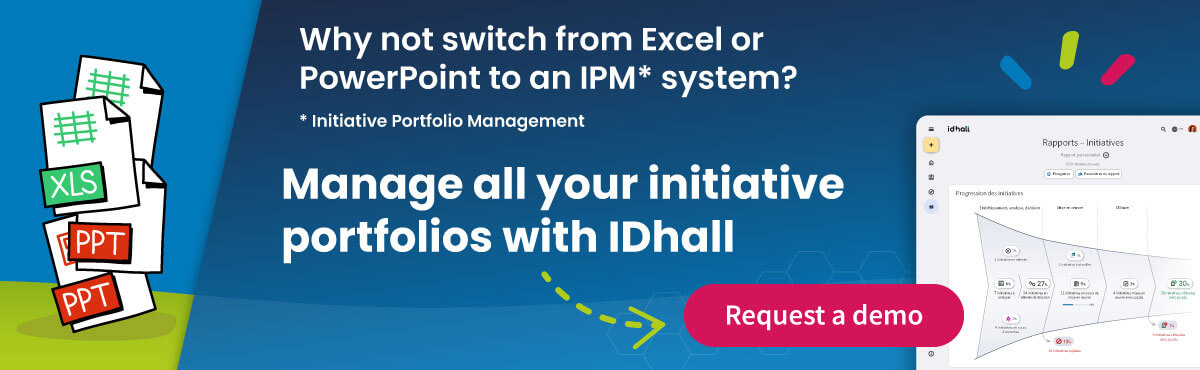
For this governance to work, you need a tool that can centralize initiatives while providing each player with a clear, personalized vision. With Excel, this level of coordination is virtually impossible: files multiply, data gets lost, and tracking becomes fastidious.
We designed IDhall to meet these needs: the platform enables you to centralize all your initiatives, while giving each user a view tailored to his or her priorities. Thanks to this approach, everyone finds their way around, interactions are fluid, and initiatives converge efficiently towards strategic objectives.
Want to know how our industrial customers are transforming their initiative management with IDhall? Read the testimonials from Orano, Sew Usocome and SWM International.